Wednesday, 25 October 2023

THE MAJOR MITCHELL TRAIL – PART 2


For Part 1 of the re-tracing of Major Mitchell’s 1836 expedition see my Pieces to Share blog posted January, 2023.


In the days when I studied Australian history the exploration of the continent was a major component of the curriculum………….along with Australia’s “discovery” (as though it had previously been lost!), the impact of the finding of gold, the inexorable spread of the land seekers and the squatters, the federation of the Australian colonies into the creation of the new nation.  This schooling was in the 1950s, and the significance of the two world wars, of the economic depression of the 1930s, indeed the economic and social achievements of the 50 years of post-Federation nationhood, were still being digested.  Moreover, the history of Australia before white settlement, and the contribution of the aboriginal races, was barely a blip on the radar.


Given the importance placed those sixty-plus years ago on the impact of the trail-blazing explorers in the early white history of the continent it’s somewhat axiomatic that Major Thomas Livingstone Mitchell does not today occupy a more significant place in the general imagination.  Clearly it wasn’t always thus.  Mitchell was a major figure in the early history of overland exploration, and was no doubt thought of as such in 1936 by the instigators of the memorial cairns.  1936 was the centenary year of Mitchell’s principal journey of exploration, the journey that was to become the inspiration for The Major Mitchell Trail volume.


The signposting of the Trail and, later, the preparation of theTrail book in 1990, are significant tributes to Mitchell’s achievements - although if the state of that signposting and the general accessibility of the Trail today is an indication, then Mitchell’s stocks these days are low indeed.  


This instalment of my retracing (with son Dan) of Major Thomas Mitchell’s expedition across the region later to become the State of Victoria covers Mitchell’s traverse in a south-westerly direction from Mount Hope to Wando Bridge near the Casterton/Edenhope Road in the south-west of the State.  It covers Mitchell’s journey from 29 June to 9 August 1836, and is described in maps numbered 6 to 12 in The Major Mitchell Trail volume.  


The book indicates that along this stage of Mitchell’s journey there are some 18 commemorative cairns, erected in the centenary year 1936; and part of our objective in re-tracing the Trail was to locate and photograph these cairns.


The Trail - Maps 6 to 12 [days 26 to 67]  

29 June to 9 August, 1836 


Traversing Victoria from near Pyramid Hill, in a south-westerly direction past the Wimmera River to the area near the Glenelg River


We started this stage at Mount Hope, where we’d previously signed off, and did a bit of retracing.  Presuming there was a walking track to the summit of Mount Hope we had intended to drive as far as possible, and then continue on foot.  We did indeed drive as far as possible, but not to the end of the vehicular track – because we were blocked by a chained gate.  Our disappointment at not being able to reach the summit (and to see the cairn) was somewhat assuaged by the blunt, but amusing, sign on the gate: 


"WARNING 

Mt Hope Run is Private Property 

DO NOT ENTER  

The Snakes, Goannas, Echidnas and Wallabies are trained to attack.  Please leave alone unless you want to be videoed being bitten, spiked,        

scratched or laughed at.” 


We explored the lower slopes a little and, across the plain to the south we were able easily to see Pyramid Hill, and further away Mount Korong.


Major Mitchell camped nearby to Pyramid Hill on 29 June 1836, and on the 30th climbed to the summit.
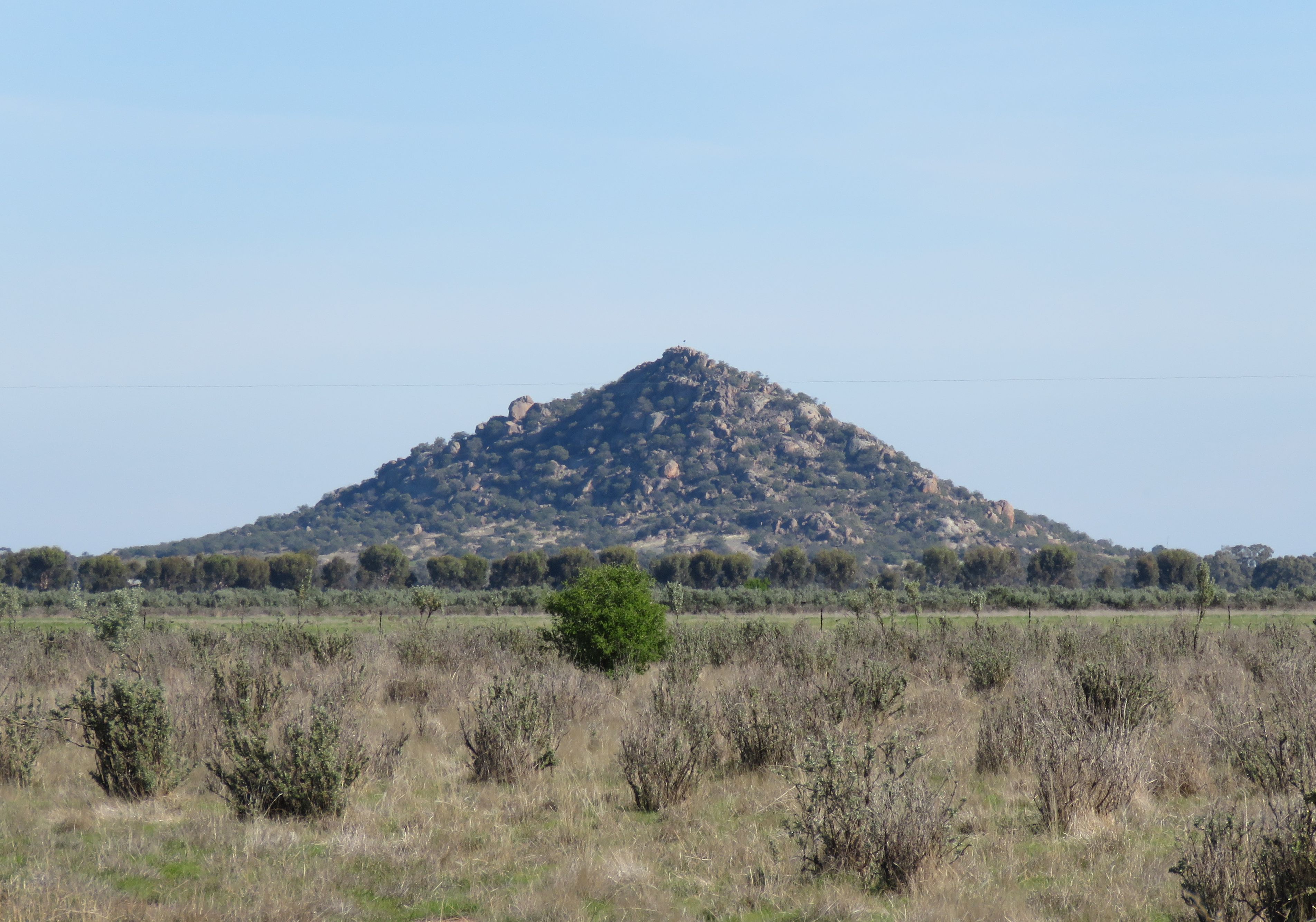

Stuart Williams on Twitter: "Pyramid Hill is a granite outcrop that rises  above the plains of northern Victoria. Let's see what's in flower there  right now ... https://t.co/SVQC8lPuJH" / Twitter


 Mitchell the surveyor measured it as 295 feet above the surrounds. He lyrically describes the vista: “Its apex consisted of a single block of granite, and the view was exceedingly beautiful over the surrounding plains, shining fresh and green in the light of a fine morning.  As I stood, the first European intruder on the sublime solitude of these verdant plains as yet untouched by flocks or herds, I felt conscious of being the harbinger of mighty changes; and that our steps would soon be followed by the men and the animals for which it seemed to have been prepared.”


What those men and animals have wrought over the succeeding years can be gauged from Mitchell’s description of crossing the Lodden River a couple of days later.  The party had to construct a bridge to effect the crossing.  Mitchell’s diary: “Late in the evening of this day (2 July 1836) we completed a bridge formed of short but strong sleepers laid diagonally to a fallen tree.”  But by morning the party were amazed to find the bridge 1.2 metres under water, the Lodden having risen 4.3 metres overnight.  There was no explanation for this phenomenon – there are no nearby snowfields, and it had not rained for five days.  How long is it since the Lodden has flooded?  How long since it was pristine?  The “mighty changes” for which Mitchell described himself “harbinger” have occurred, although not all have accorded with his vision.


The boats were needed to assist with the crossing, which took all day.  Mitchell’s diary throws an interesting spotlight on the logistics of the river crossing and, specifically, on the central role of the aboriginal guide, John Piper: “This was a very busy day for the whole party – black and white…….in tracing lost cattle, speaking to ‘the wild natives’, hunting, or diving.  Piper was the most accomplished man in the camp.  In person he was the tallest, and in authority he was allowed to consider himself almost next to me, the better to secure his best exertions……….The men he despised, and he would only act on my orders.” 


On 4 July 1836 the Trail volume records that Mitchell, for the first time since leaving the area of the Lachlan River in New South Wales, “reached undulating ground”.  On 5 July Mitchell led a group on horseback to Mount Korong.  “Most of the ascent was over granite rocks.  They had just reached a bare outcrop near the main summit when fog came down and compelled them to return…..”  In 2023 we were equally out of luck, with restoration and track works having closed the ascent.  There was, though, a commemorative stone with bronze plaque – not from 1936 however. 


There is also a commemorative cairn beside the Calder Highway to the south of Wedderburn, where Mitchell passed by on 7 July 1836, 


 and another beside the Bendigo/St. Arnaud Road near Kooreh.  This flat-topped cairn was erected by local residents in 1955. 


This place Mitchell describes as: “……one of the most beautiful spots I ever saw…….(with) the appearance of a well-kept park, that I felt loth to injure its surface by the passage of our cart wheels.”  


I am mortified to report that, despite my earlier comment in Part 1 of this blog to the effect that Mitchell did not seek amity with the aboriginal peoples by proffering “beads and shiny tomahawks”, I find that on 8 July 1836 Michell gave an iron tomahawk to an old man in gratitude for describing the country ahead.  That description: “Well watered and grassed, and with no barrier to reaching the coast.”  But by this juncture Mitchell had become disinterested in heading for the coast – because on 10 July 1836 he had his first sighting of the Grampians; and on 11 July, away in the distance, he sighted, and named the Grampians peaks Mount Willian and Mount Zero.  


Mitchell made camp beside the Richardson River on 12 July, using this site as a base for a three-day sidebar excursion to the Grampians, specifically to Mount William. 


The next day Mitchell set out on horseback with six men, charging his second-in-command, Stapyleton, with the task of fording the expedition across the Richardson River.  Mitchell described the grassy forest land they entered soon after as “one of the finest tracts they had ever seen”; but after crossing the Wimmera River (the name ascertained by Piper from the local aborigines) they found the country to be quite different – poor sandy soil, and stunted vegetation.    


Leaving the horses grazing in the care of Piper, the party, with some difficulty, scaled Mount William on 14 July.  


“The first part of our ascent, on foot, was extremely steep and laborious…….the upper precipice consisted of cliffs, about 140 feet in perpendicular height……Fortunately the ablest of the men with me was a house carpenter and, being accustomed to climb roofs, he managed to get up, and then assist the rest……Having gained the top…..we found winter and desolation under drizzling clouds.”  The party spent a miserable night on the summit of Mount William.  “We succeeded in keeping the fire alive, although while twigs were blown into red heat at one end, icicles remained at the other.”  Two days later, after the Mount William party had returned to the Wimmera River, Stapylton recorded in his journal: “The Surveyor-General’s constitution must be as hard as iron, to stand three days of it without food, wet through the whole time, a bitter wind from the Southward on the summit chilling the frame violently heated with perspiration from the fatigue of the ascent……But he appears not at all the worse for it at present but positively in better health.”


Several days were spent in the shadow of the Grampians (which Mitchell named with due deference to the mountains in his native country), and in the vicinity of the nearby Wimmera River.  “The richness of the soil, and the verdure near the river, as well as the natural beauty of the scenery, could scarcely be surpassed.”  


Passing around the northern extremity of the Grampians, Mitchell made a diversion to the landmark Mount Zero on 20 July 1836.


Colours and Art of Mt Zero | The Gap Year and Beyond 


From Mount Zero Mitchell observed that west of the Grampians it was comparatively low country, hopefully making it possible for him to reach the southern coast. 


But, further again to the west, Mitchell had observed a striking outcrop, with “a most remarkable rock resembling a mitre” near to its base (Mitre Rock), and he resolved, “before turning southwards, to extend our journey to the isolated mass…..which I afterwards named Mount Arapiles”. 


Returning to the main party, Mitchell passed Green Lake, and camped nearby.  


The next night’s camp (21 July) was close to the Wimmera River.  “Mitchell was anxious to learn where the Wimmera went beyond this point.  Mount Arapiles was ahead and he wanted to know whether the stream flowed to the south or to the north of it……..Mitchell hoped he could follow the river south to the coast."  


The 21 July 1836 campsite was not so far from present-day Natimuk.  Today, in the centre of town, there’s a plaque on a large boulder noting that Major Mitchell passed close by on his way to Mount Arapiles.


  Mount Arapiles is a striking monolith, much used in later times for rock climbing and associated pursuits.


There is a macadamised road to within 100 metres of the top, and walking tracks from there; but the most striking feature is not the view of the plains in all directions from the summit, but the view of the rockface from the campground below.  The Trail book unapologetically describes Mount Arapiles as “probably the best and most famous rock-climbing site in Australia”. 

Rock climber leading the classic Scorpion Corner on Mount Arapiles, Arapiles-Tooan  State Park, Stock Photo, Picture And Rights Managed Image. Pic.  UIG-961-13-GNT00002 | agefotostock 


The Wimmera River features for much of Mitchell’s journey over the next couple of weeks.  Rather than running to the sea, Mitchell determined that the river flows generally north.  His travels did not permit him to ascertain that the Wimmera disgorges into Lake Hindmarsh, then on via Outlet Creek to Lake Albacutya, thence with sporadic flow into Wyperfeld National Park and the rarely-filled Lake Brambruk.  The most recent, and likely last, time Lake Brambruk received an inundation was in 1975 (before that 1910, 1917 and 1957).  As a family the Andrews were able to camp at Wyperfeld in 1975, and to see the newly-flooded Lake Brambruk; and then again, in successive years, to observe the crop of burgeoning riparian River Red Gums that flourished as the flood waters slowly receded, never since to return. 


From the summit of the Mount Arapiles massif Mitchell was able to look back to the Grampians, including Mount William some 86 km distant.  


Further on, near Miga Lake,


 Mitchell camped for three nights – 26 to 28 July 1836.

Picture of / about 'Miga Lake' Victoria - Miga Lake 
 

The time there was spent in recuperation (the bullocks were flagging), maintenance, and local exploration.  


On 27 July Mitchell sent Stapylton, with one offsider, scouting forward, but became alarmed when the pair failed to return by nightfall.  The next morning two search parties were dispatched; then Stapylton returned safely, having gained some 32 kilometres from camp.  And one search party returned in response to the signal shot.  The other search party, led by the aborigine Piper, returned some hours later having encountered some natives.  These natives seemed hostile; one readied to throw his spear; Piper urged retaliation, and the native had been shot in the arm.  


Over the next twelve days the expedition travelled steadfastly south to south-east, although on the Trail map the route gives new meaning to the word meander.  


Flat ground had to be found, although not so flat as to be swampy.  And, then, the Glenelg River – which Mitchell initially named the Aboukir, after the Secretary of State for Colonies – had to be forded.  The river was deep (3.5 metres) and full (35 metres wide), and the crossing by the expedition took the whole day of 31 July 1836.  One bullock drowned. 


The next nine days were difficult for the expedition.  Progress was slow.  Uneven terrain, with ravines and gorges often obscured by dense vegetation; ground so soft that the drays sank to the axles.  But all interspersed with “land beautiful, fertile and well watered, with good potential for farming or cultivation”, and “beautiful country, of streams, very attractive woods and grassy hills”.    


On 4 August the expedition split into two groups.  “The main party had to remain behind with the carts, having broken many of the chains and a shaft in their efforts to extricate the carts and the boat-carriage from the mud.”  They rejoined the main camp the next day, and the day was spent on repairs and on building a bridge over the creek ahead.


After more days of generally adverse conditions (on 7 August they covered 1.5 kms only), the party was again surrounded by soft ground, and could “extricate themselves only by floundering through it.  They had to take the loads out of the carts and carry them across by hand and then push the empty vehicles on to firmer ground”.  Looking forward to better conditions the next day (9 August 1836), the members of the expedition were rewarded with nine kilometres of “green hills and running brooks”…….until they reached what is now known as Major Creek, “a ravine with such steep sides that it was extremely difficult to move the vehicles down”.  The slope was tested with a light cart, but the incline was still too great.  “The cart, together with the bullock pulling it, tipped over, depositing all Mitchell’s instruments under it in the bed of the stream.”


Camp was eventually established on the far bank…..and there we leave The Major Mitchell Trail, Part 2.  Those so breathless with anticipation that they can't bear to wait for Part 3 will be happy to learn that Mitchell’s instruments were recovered intact, and that the bullock was unharmed.


To be continued………


Gary Andrews


Wednesday, 19 July 2023

BRITAIN IN PICTURES - NUMBER 10


#24  English Social Services by Sir George Newman


The fly leaf can usually be relied on to provide an indication of what is to follow; and it can be relied on never to be impartial.  In this case the fly leaf contains a quotation from the author, Sir George Newman: “The origin of our Social Services lies mainly in the fixed and ancient laws of England; and partly on the beneficent devices of voluntary social aspirations and mutual goodwill.  It is a strange medley of State regulation and humanitarian endeavour.  Both derive from similar, if not always identical, sources of the heart, mind, and will of free people.  Both have similar instincts and aims, and adopt democratic methods for their fulfilment.  Both are inspired by the kind of humanism which has made England what she has been and is.”  Overblown and turgid, but we get the idea that the overarching principle behind social services is humanitarian, principally humanitarian outreach by government.  


The blurb goes on to describe Newman, as “one of the greatest authorities in the world on Social Welfare and Public Health”, and adds that he was for many years Chief Medical Officer to the Board of Education.   


It would be interesting (I think) to compare the landscape of social services in England in 1941 when Newman was writing with that landscape today, and interesting to compare the English scene with the Australian scene; but this is thesis territory and not for here.  There has been little change to categorises of social services perhaps, but a lot of ebb and flow.  In presenting his Table of English Social Services Newman is cautious: “We cannot classify social services in any concise, mutually exclusive or completely satisfactory form, partly because they are inter-dependent, and partly because each group of beneficiaries is not fixed or completely exclusive at any one time”.  Below is Newman’s Table, much abbreviated. I have omitted “War emergency services”, which category has thankfully disappeared: 

A.  Public assistance for necessitous poor.

B.  Fundamental community health services for all - with some seven sub-categories such as public health (sanitation, water supply), public medical services (maternity and infant welfare, nurseries and pre-schools, health centres, hospital services, dental clinics etc.), education, housing and town planning, “social recreative schemes”, industrial welfare, and “research for new knowledge and means of application”.

C. Social insurance (pensions, unemployment assistance, health insurance, workmen’s compensation).

D. National savings schemes.

E.  General social services (libraries and museums, police, sports, communications and transport, Boy Scouts and Girl Guides).


Newman’s table surprises, not only in the wide range of government services that he chooses to categorise as “social” services, but in the fact that these were fully functioning in the England of 1941.


Looking for comparison I have dug, but not too deeply, into the categories and the depth of the situation in today’s Australia, namely a short perusal of the website of the Department of Social Services.  The site has a page that lists “Our Responsibilities”.  [These, notably, do not include either Health or Education – each sufficiently important to have been broken off from Social Services, and awarded departments of their own.]   And those Social Services responsibilities in Australia are listed rather generally (in contrast to the specifics of the 1941 British list), as:

       Communities and Vulnerable People

Disability and Carers

Families and Children

Housing Support

Mental Health

Seniors

Women’s Safety

Working Age

Welfare Reform.


We could spend hours trying to understand the relevance of the differences between the two nations, and the changes between the two eras - to little avail.


It is clear that Newman takes a high moral stance - the social services that the community should enjoy should be provided as service.  “The services to be considered may best be conceived as those which are fundamental to primary human needs…….What does the natural body of man really require in order to live at the top of its whole physical capacity?  What does the mind and spirit of the ordinary man need in order to win the happiness, power, and competency with which he is potentially gifted?”  Echoes of Thomas More’s Utopia, published in 1516!


All very worthwhile, and enough said I should have thought, but Newman lays it on a bit thick with references to the life and doings of King Alfred.   “He lived solely for the good of his people, the first instance in the history of Christendom of a ruler who put aside every personal aim or ambition in order to devote himself absolutely to the welfare of his people.”


Notwithstanding Alfred’s noble example, a thousand years passed before Newman is able to identify the birth of English social services with the Poor Law of 1601.  Under this, for the first time in history, it became illegal to let anybody starve, and local parishes were obliged to give cash or food to those who could not afford to eat.


As already indicated, I shall forgo a more extensive analysis of the social services landscape either in England or Australia, or in 1941 or today.  Instead, I pose the question: where, as a nation, would we be without social services?  The simple conclusion: The ways in which, and the extent to which, a nation cares for its people is surely the mark of its degree of civilisation.  Moreover, civilised nations, those already with extensive social services, should be ever alert to budgetary claims that the current social services can no longer be afforded.  In this area, at least, head should not rule heart.


#117  The House of Commons by Martin Lindsay


The annual break at Coolum Beach in Queensland has become a regular fixture for my wife Annie and me (Covid permitting); thus, too, the four-day road journey from Melbourne, each year via a different route, taking in things new and things familiar, the car filled with our stuff, and clear proof that we could never manage it by air. One of the abiding features of each year’s trip is the audio downloads and the newly-borrowed clutch of audio discs - current affairs, celebrity interviews, and fiction.  This year’s highlight was a reading of Paul Gallico’s Mrs. ‘Arris Goes to Parliament.  


Gallico was an American author (1897 to 1976), early a sports journalist, later a novelist and short story writer, many of the stories published in The Saturday Evening Post (1821 to date, although today much diminished as a bi-monthly).  His works include four whimsical novels detailing the exploits of Mrs. Ada Harris, London charwoman – a woman of no formal education but of considerable wit and courage. The books are old fashioned exemplars of the triumph of the human spirit - to be avoided, however, if one is bent on shunning warm and fuzzy feelings.


In Mrs. ‘Arris Goes to Parliament the heroine indeed does go to Parliament, winning a seat in the House of Commons.  But her victory was not all it seemed, and nefarious forces had been at work; and Mrs. Harris was sadly out of place in the Commons, and grievously humiliated.   


The point of this discursive preamble is to advise that before I started to read Martin Lindsay’s authoritative study of the House of Commons I had already been primed by listening to Paul Gallico’s colourful introduction to the House, Ada Harris version.  


I have previously mentioned my admiration for the ability of the editors of the Britain in Pictures series to select authors appropriate to the subject topic, indeed authors both of relevance and eminence.  Picking up The House of Commons I started with the bare name Martin Lindsay on the dust jacket, progressed to Martin Lindsay M.P. on the flyleaf, and landed in Wikipedia with Lieutenant Colonel Sir Martin Alexander Lindsay Bt., CBE, DSO (1905 to 1981).  As a serving Member of Parliament Lindsay was well placed, in 1948, to write this survey.  At the time he was, additionally, described as army officer, polar explorer, and author.  Lindsay's Parliamentary years were unremarkable - for instance he never served in Cabinet - but he seems to have been a general all-round commentator, unafraid to speak out, something of a vocal burr under the saddle of the body politic.  I realise that much of his political activity post-dated his authorship of The House of Commons, but can't resist referencing some of his lifetime of disparate pursuits.  He was commissioned into the army after graduating from Sandhurst; he spent several stints in Arctic exploration, including as leader in 1934 of the British Trans-Greenland Expedition (and published about his exploits).  Having left the army in 1936 he pursued a career in politics, without success.  From the commencement of the World War he returned to the army, with his Arctic experiences fitting him for the Norwegian campaign.  He successfully returned to politics, and entered Parliament in 1945.  Lindsay’s post-War public life might be described as sporadic rather than consistent but, then, he had raised the bar high.  He retired from Parliament in 1964.


And, in addition to all this, Lindsay knew the hiding place of sufficient bodies to be awarded a baronetcy in 1962. 


As to the book itself: Lindsay’s essay is comprehensive, both as to the function and operations of the House, and as to its history as an institution.  Here are some snippets:


#. “In England it is the House of Commons that is the guardian of the people’s liberties, which twenty generations of Commons men have helped to consolidate.”


#. In the seventh century a religious fraternity established a community on an island in the Thames, to which, some centuries later, Edward the Confessor added a new abbey – known as West-Minster, in acknowledgement of the (earlier version of the) already-standing St. Paul’s to the east.  And Edward built himself a home nearby, the origin of the Palace of Westminster (today’s Houses of Parliament). 


#. Westminster Hall, the largest (and oldest surviving) feature of the parliamentary complex, dates from 1099.  The hammer-beam English oak ceiling was commissioned by Richard Second in 1393.


#. Trivia:  When the ceiling had to be replaced in the 1920s because of the ravages of death-watch beetle the replacement oak was obtained from the same Sussex family estate where the earlier oak had been sourced some 600 years prior.


#. For centuries the Palace of Westminster was the principal residence of the monarch - it remained so until Henry Eighth moved out after the disastrous fire of 1512.  It was convenient – convenient for the King - for the Parliament to meet close by.  


#. Over the centuries the role of the Commons has evolved, and its power has increased.  Early on, Councils of State comprised the King, chief officers of state, and the senior feudal and spiritual lords.  Then, “in 1254, each county sheriff was bidden to send two knights to Parliament. This established a precedence of great constitutional importance. Firstly, because these representatives were to be chosen, not by the Crown, but by those whom they were to represent; and secondly, because they were summoned to consider what aid they would give to the King in his great necessity.  Thus began the power to grant or withhold supplies, the lever which was subsequently used time and again by the representatives of the people in their efforts to control the activities of the King and his executive.”


#. Lindsay continues: “And it is this power of the House of Commons to withhold the revenue without which no government can govern for any length of time, which is still to this day our greatest safeguard against tyranny." 


#17  English Education  by Kenneth Lindsay


One of the study techniques from my schooling - schooling which was occurring not that long after Kenneth Lindsay was authoring this book in 1944 - was to get the sense of each paragraph from its first line……….and then to skip the remainder of the paragraph.  So, I thought to apply this approach to the Introduction section of Lindsay’s little volume.  


Here goes:  

There can be little excuse for adding to the number of books on education.   Oh dear!  Never start with an apology for what you’re about to do.  


The story of English education is a strangely neglected subject.  A reasonable thesis, and in subsequent pages Lindsay elaborates: the State had become involved in education only in the previous 100 years; the Board of Education was a mere 40 years old; historically, schooling in England is essentially social rather than educational!  


What is the object of education?  Here Lindsay answers his own question with a conundrum: if, as Aristotle asserts, education “should enable a man to live well”, why does England allow organised education to cease for four-fifths of the population at age fourteen?  


No easy description of a system of schooling can explain the British character.  Lindsay rather misleads with this simple statement.  At first sight, to me at least, it implies that the British character has somehow evolved (and coalesced) regardless of the particular system of schooling that individual citizens have experienced.  Indeed, he implies worthwhile outcomes regardless of the nature of the child’s education.  He elaborates with examples:  

Case one:  The growth of a child educated five days a week in a Grammar School is enhanced by “the essentials, the home and family circle, food, rest, holidays and social ties”.

Case two:  Whereas, picture “a boy who returns from boarding school to a home rich in associations and sometimes in culture or to some small estate where he can roam at will, pursue his hobbies and hear talk of State and local affairs”. 

Case three:  And contrast “the home of a miner, a keen trade unionist or local preacher, and the rich background from which the son or daughter proceeds each day to the local school”.


To my mind Lindsay is unconvincing and fanciful.  He is missing, I think, the opportunity to note that the educational system is far from egalitarian.  He is failing to point out the divisive nature of the educational outcomes of economic advantage.  


English schools have at their best a dual purpose.  First, “they are miniature communities, symbolic of a better organized state and centres of resistance to the vulgar commercialism of their day”.  [I do not understand this.]  Second, “they prepare young people for the dignity of self-support”.  Hence, domestic skills need no longer be learned under the eye of one’s mother – the school will do it; and technical skills are taught outside the venues of practical experience 


 And, remembering that this book was written after several years of ongoing war, and with concern for the pressing situation of Britain’s young people, there is this passionate outpouring:  “To-day, owing partly to the revolutionary discoveries of modern science, partly to the spread of purely specialist training even in the Universities, partly to the repetitive nature of modern industry, and partly to the slow disintegration of old cultures, there has appeared a world-wide restlessness among youth.  Hitler and Mussolini have tried to fill this vacuum by harnessing the energies and spirits of youth to strict, disciplined, national training and to the lure of the battlefield.  The English faith is that there are other methods.”


The remainder of Lindsay’s study is a little tame after this.  He traces the history of the growth of education, his assertion being that it started with King Alfred who translated the works of the Venerable Bede from Latin into Anglo-Saxon, and founded the first school to train the sons of noblemen for public service.  Lindsay takes us through the growth of the universities and the grammar schools, and (for instance) the spurt in the learning of navigation and engineering triggered by the emergence of English sea-power in Elizabethan times.  Lindsay’s subsequent story is complex but diverting, bringing his history to an epiphanic close at the introduction in 1918 of compulsory schooling to age fourteen.  [The State of Victoria had compulsory free education to age fifteen, from 1872.]


From then the narrative loses its savour: he talks of recent developments, of local education, of nursery schools, of training for industry; and has much to say on the future of universities.  His final words are testimony to the reality that “education” can never be static.  He recounts that a report written 300 years prior, in Cromwell’s time, stated that: “They are eagerly debating on the reform of schools in the whole Kingdom, namely that all young people should be instructed, none neglected.”  At that time, Lindsay notes, “Cromwell’s army was engaged in civil war; to-day [1944] the armies of freedom are engaged in an international civil war.  In every country education is on trial; it is for teachers and parents alike to awaken to the challenge.”  The more things change, the more they stay the same.


Gary Andrews


Saturday, 13 May 2023

BARCELONA/FRANCE/TURKEY – TRAVEL DIARY 2003 - PART 7 of 7


Transcript of Tape-recorded Diary


PART 7 of 7


Ankara is a huge city - possibly four million people - secular, bustling, modern. The internet has several websites that detail the population of Turkey by regions, and list the major population centres.  The most recent figures, for cities of more than a million population, are:

         Istanbul           9.2m                       Konya                1.9m

         Ankara            3.7m                       Adana                1.7m

         Izmir                3.1m                       Bursa                 1.2m

That evening, a free evening, free in the sense that Simon had not arranged for us to be together, some of us walked the streets near the hotel - and with Faye and David we enjoyed the unaccustomed luxury of a McDonald’s snack.  We’d previously asked for a beer at a pavement restaurant and been told that beer is not available in that particular street but the next street along is the place to go.  We went there, had our beer, and were surrounded by hundreds of Turkish men enjoying their beers together in a dozen separate outdoor restaurants, each of which had up a large television screen for the evening’s soccer match.  The custom of Turkish men meeting together for drinks, snacks, cards, dominoes - and now TV watching - to the total exclusion of female company that we’d seen in each of the centres we visited was here being replicated on a massive scale.  Despite the fact that this is their way we, frankly, found it quite distasteful.


Between Urgup and Ankara we visited our second Dervish lodge, at a place called Hacibectas.  We’d previously seen one of these lodges two days earlier on the Wednesday.  The Whirling Dervishes are a sect of Islam that arose around the year 800, about two hundred years after the prophet Mohammed had founded the religion.  They were not more fundamental and conservative, but nonetheless felt that Islam needed to be reformed, and they took that reform in the direction of mysticism.  The Whirling Dervish dance, with the simple black and white costuming and with one hand cupped upward towards heaven and one hand cupped downward to the earth, symbolised the transmission of God’s spirit.  


Image of Whirling Dervishes Whirling Dervish Museum Istanbul Turkey |  mikestravelguide.com


These lodges were set up by the leaders of the sect and were in fact monasteries with communal living, extensive kitchen facilities, and the whole premises giving the status of monks.  And even today visitors, although the premises have been de-sanctified and converted into museums, are expected to remove their shoes and wear respectful clothing.


Konya is a very large city - the fifth largest in Turkey [actually fourth] - and we passed through it on our way from Egirdir to the Cappadocia region.  In addition to the location of our visit to the first Whirling Dervish lodge and its attached museum, it was also our lunch stop - although not for me.  I was full up with food and decided to spend the hour walking the nearby streets.  I was befriended by Mehmet and Mustafa.  Depending where else in the world you’d say “accosted”, but in Turkey it’s “befriended”.  Mehmet spoke good English and wanted to practise on me - his friend Mustafa spoke no English at all - and we walked together along the streets for several hundred metres before I had to retrace my steps, and they went their way.  During my hour I walked through a huge cemetery.  We’ve seen cemeteries in small villages and in many places, and have marvelled at the way in which they’re often tucked along the roadside or stuck on a stony hillside.  Heaven help those who have to dig the graves.  But in Konya the land was quite flat and the scene was tranquil although cluttered.  The gravestones are typically much smaller than gravestones in Australia and almost always of white stone, probably marble.  And the headstones are almost always of the same stone, although some are dark stone with no inscriptions.  The white headstones are tall and narrow, about two feet wide at the most and standing about four feet tall often with ........... [missing]

Tape 4, side 1


The other notable stop on our way from Egirdir to Urgup was the caravanserai at Sultanhani.  I’d always known a caravanserai as a camel train but here the real meaning became apparent. 


Sultan Hani Caravanserai, Turkey 


It’s an enormous fortified structure to protect travellers, and to be a trading post in its own right, with space for all the animals and a sizeable population, although none of the dwellings is extant.  These caravanserai were set up hundreds of years ago, at intervals of some forty miles, by the reigning powers in acknowledgement that this part of central Anatolia was a focal point for the trade with the East.


Our trip through Turkey has been an ideal mixture of history and culture and scenery.  We’ve covered nearly 4000 kilometres.  A bit arduous sometimes in the bus, but certainly not life-threatening, and although Turkey has more than 1500 so-called historical sites, during our fortnight we’ve seen - so they tell us - the majority of the most important ones.  I’ve already talked of Troy and Pergamum and Ephesus and Hierapolis.  Two other magical places were Alinda and Aphrodisias.


We saw Alinda on Friday the 26th, on our day between Selcuk and Dalyan.  Alinda was set up by Queen Ada who was exiled from her own nation but later did a deal with Alexander the Great in return for which she gained immunity from his armies and treated him as an adopted son.  Ada was a queen of the Carians, a nation of lower Anatolia, identifiable from before 800 B.C.  They may have had their origins in Crete, or from Aegean pirates - anyway they were seafarers.  They survived incursions from the Athenians and the Spartans; and retained a degree of independence under later Persian rule.  Then came Alexander, taking control with Queen Ada’s help.  There was a power vacuum after Alexander - until the Romans.  Caria prospered under Augustus Caesar, and didn’t decline until about the end of the Roman empire, fragmenting into a collection of coastal towns. The most notable Carian was King Mausolus (King from 377 to 353 B.C.), who ruled from Halicarnassus, and whose tomb is included as one of the Seven Wonders of the World, and from whose name we have the word mausoleum.  Sited high on a hill, and with no tourists other than ourselves,


 the ruins, dating from the 340s B.C. with later Roman additions, had a magical feel, especially the modestly-sized amphitheatre.  The seating area, virtually intact, with three or four impertinent olive trees growing where they shouldn’t be.  A place to sit for a few hours - dreaming of princes and potentates, and marvelling at the vanity of it all.


The Alinda ruins sit above the small village of Karpuzlu, meaning watermelon, a delicious name that belies the conservatism of the local people; and on our descent from Alinda and walk through the town Simon asked the ladies to cover their shoulders and had previously asked them not to wear shorts on the day.

Aphrodisias, which we visited on Monday the 29th, was stunning in a different way - stunning because of its vastness and because of the way in which it’s been excavated.  The driving force behind its excavation was an American archaeologist of Turkish extraction, and New York University.  True to say that American money has made it all possible; and the work continues.  Unlike other places the tourist entrance is a delightful area of lawns and gardens with a reconstructed Roman gateway.  A delightful and welcoming introduction to what lies ahead, and in considerable contrast to the dusty arrival at Ephesus, say.  Some of the significant civic buildings of the city have been excavated but much remains yet to be done. 


 The most exciting building is the stadium - not to be confused with a hippodrome, the place for chariot races, or with a theatre for dramatic performances.  The stadium was for the games, the athletic games.  It’s a great oval structure, all the seats are still there, and the sporting field some 400 metres long.  Hamish did the 400 metres dash and against no opposition whatever was the clear winner.  Sadly, there was no laurel wreath to present.


Back in the parkland sitting at Aphrodisias there’s a new museum building housing a collection of the statuary and other artefacts unearthed at the site.  The marble used by the Romans has a wonderful lustre, and because it’s a soft stone it’s pretty lucky to find a piece that hasn’t got bibs and bobs missing.  Nevertheless, the collection at Aphrodisias leaves you in no doubt about the might and the majesty of the Roman Empire.

It was the day after Aphrodisias that we’d visited Hierapolis, and cultural indigestion was a prospect, but a prospect avoided by the fact that Hierapolis is sited right at the amazing natural feature of Pamukkale.  Pamukkale is another world heritage-listed site and it’s an astonishing natural formation of white solidified salt deposits down a long hillside - a waterfall effect resulting from millions of years of flow from mineral springs high up on the hill.  And it’s because of these mineral springs and their therapeutic effect that people have been coming to this site for thousands of years, and the reason why Hierapolis itself was established further up the hill.


 Because of the adverse impact of tourists, the site has now been managed, with the water flow being diverted through a man-made channel; and the various pools are now off limits - but this is all to the good.  It’s possible to bathe in the mineral pool but this is now a tourist complex and there’s an admission charge.  Three of the group took the plunge.


After Pamukkale we were on to Egirdir, on the shore of Lake Egirdir; and the only point of importance to note is that Anne had a swim in the lake, reporting that the water wasn’t as cold as the water had been at a couple of the hotels.  The bottom, however, fell away very quickly from the shore and it was pebbly, and she found it very treacherous getting out.


Another break from the culture-fest had been our time on the gulet.  The gulet is a type of local boat - sailing boat, two masts, but motorised and I would expect the sails are rarely used.  A tourist boat with accommodation for our group of seventeen - Salih the driver and Sinan the silent guide didn’t accompany us - plus the family of four erstwhile fisherfolk who own and crew the boat.  And do the cooking.  The food during our two water-borne days was probably the best we’ve had in Turkey.


We picked up the boat on Saturday the 27th.  We’d spent the Friday night at Dalyan on the coast, and first thing on the Saturday morning enjoyed the bonding experience of a mud bath together.  We took a local riverboat up river a few kilometres from Dalyan to a little tourist complex that has a mud pool.  We immersed ourselves, caked ourselves with mud, stood around in the sun till the mud dried looking very much like creatures from the black lagoon.  Photo opportunity. 


 Powerful showers to get the mud off.  Back on the riverboat and down the river to the open sea, around the sandbars and through the narrow river mouth, to the gulet waiting for us to board.  
On the journey downstream we passed under rock tombs, high up on the cliff-face, with extraordinary carved portals.  Fourth century B.C.  And we disembarked and strolled through the ruins of the ancient Carian city of Caunus.  The amphitheatre was spectacular.  Caunus prospered and survived despite its reputation as an unhealthy place - the nearby marshes harboured malaria.

We spent two nights on the gulet, the days spent cruising around the southern coast of Turkey


 - not travelling far, not travelling fast - reading, sunning, swimming.  There was room on deck for all of us to sleep above if we wished.  Many did.  Card games and joke telling at night, and my portable CD player got its first and only airing in Turkey, with considerable enjoyment from the “Best Hits of the 60s” and Blossom Dearie.


Dalyan had been a busy tourist port, and equally so Fethiye where we disembarked on the Monday morning, the 29th.  A large and sophisticated town with good shopping, a European air, a big fish and grocery market; and, on the drive out of town, miles and miles of glasshouses. A very fertile and productive area.


- - - o O o - - -


And here we are back in Istanbul.  I recorded yesterday afternoon sitting in the garden restaurant on the top of our hotel - the Orient Express Hotel - pretentiously, according to its brochure, offering all the luxury of the famous train, even though it’s only three star.  But it’s a good place, and our only complaint is with the food - not really up to scratch - but the location is great.  We had our meal last night in the hotel roof garden overlooking the Bosporus, undoubtedly one of the great city views on the planet.  Every so often Jim would call “ten seconds” and we’d all look out to sea - to remind ourselves for a moment of our good fortune.


Our tour group hotel had been the Orsep, a hundred metres or so around the corner, and although we’d spent the Saturday night there after the tour ended, we had to move to the Orient Express for our final two nights.  The Orsep, I think, is totally committed to tour groups - one moves out and another moves in, and Simon having presided over our farewell dinner on the Saturday night was back at six o’clock on the Sunday evening doing his introductory meeting with his next bunch of pilgrims.


We’ve been fortunate, I think, to be located in one of the older parts of Istanbul and within walking distance of so many of the great cultural attractions.  And right by Istanbul’s sole tramline, which in turn runs down to connect with the train to the airport - so a location easy to recommend to any other visitors to Istanbul.


Our arrival in the city was just over a fortnight ago, but it seems a world away.  Our little hiccup at the airport was soon overcome.  We’d been instructed, when leaving the departure gate, to look for someone holding a sign with the name Pasha Tours, but there was no such person.  David and I patrolled up and down the dozens of people holding placards with names of individuals and organisations, and then at Anne’s suggestion we simply asked another tour operator, assuming that they’d be known to each other.  The one we spoke to was Tempo Tours and his response: “that’s me”.  When we later looked at our travel agent’s literature we saw the name Tempo, and when we looked at the guide and the driver who took us to the Orsep Hotel, we noticed that notwithstanding the Tempo placard their shirts carried the Pasha Tours monogram.


The first day of the tour was spent in Istanbul itself, and we commenced, after a short walk up the hill, with the local guide Mustafa, the very expert local guide who took us first to the area that was the site of the old Roman Hippodrome - an area still bearing the same name.  Parkland, a meeting place, and two obelisks - one of them brought from Egypt, a companion piece to the ones on the Thames Embankment and in the Place de la Concorde. 


 From the Hippodrome to the Blue Mosque, an extraordinary structure built by the sultan as his own personal mosque, not personal in the sense that it was for him alone, but in the sense that this is where he used to pray.  
Not blue on the outside but blue tiling inside, massive interior space, and a fitting use for the word awesome.  Multiple minarets, the sign of the sultan’s mosque.


From there just across the way to the Topkapi Palace, the Palace occupied by most of the Ottoman sultans.  The beauty and the opulence and the grandeur is indescribable ..... so I shan’t try.


The group dispersed at this point and - get this - Anne and Gary had lunch at the Palace; and then we walked to and through the Grand Bazaar, described in the literature as having 4000 separate shops and you’d better believe it, we certainly had 4000 invitations to buy. 


 Very laid-back shopkeepers, and very little badgering of potential customers.
 And from there, after seeking directions a number of times, we found our way to the Spice Market, coming full circle back to the hotel only a couple of hundred yards away.


Two weeks on, we had an early 7.00am start on Saturday from Ankara, arriving at Istanbul at 2.00pm.  The terrain hilly to mountainous most of the way, very picturesque.  Couple of short stops, at one of which Anne acted as spokes for the group and said some words of thanks to Salih our driver and presented him with the remains of our tipping kitty.


- - - o O o - - -


Well, it’s Tuesday morning, quarter to six, our last day in Istanbul and the last day of our trip.  We’re being picked up from our hotel at five to eleven, and later this morning we’ll be visiting Suleiman’s Mosque, the mosque built for Suleiman the Great and described in the guide books as the biggest and best mosque in Istanbul.  Some boast.


It’s very quiet in the street this time of the morning, the first tram hasn’t come by.  The cats, as always, are stealthy.  A garbage truck appears in the distance, and the daily clean-up begins.  Yesterday was a warm day again, say 26 degrees, but last night there was quite a stiff breeze and our waiter assured us that it would rain - certainly rain tomorrow, that’s today - but it hasn’t yet rained.  The breeze is still fresh but it’s a delicious morning.  I’m in shirt sleeves, although it will be long trousers today for the trip home.  If the rain comes I guess the temperature will fall but hopefully we’ll leave all that behind us.  We’ll also leave behind us such wonderful memories of the great city and the great country, spectacular scenery, the enthralling history, memories of the wonderful people and of the spectacular good weather, and of our friendly travelling companions, the last of whom - the eight of us from Melbourne - are dispersing this morning; while at the same time Simon Boas leaves with his latest group on the first day of their Anatolian journey.


As the first tram for the day passes by - a long tram, four joined sections - and as the electronically detached voices of the muezzins start up all over the city, I’ll try to capture the missing bits of our nearly seven weeks away.


On Sunday our first task was to transfer hotels.  Check-out time at the Orsep was midday but check-in time at the Orient Express wasn’t until 2.00 p.m.  But at the Orient Express they have a secure baggage room and we simply trundled our bags a hundred metres around the corner and locked them up; then hit the road.  The first stop was the Byzantine Cistern, the underground tank used in early years as the water storage facility for the city, the water having being brought from some distance away. 


This is an enormous structure with some hundreds of columns supporting the roof, the columns of marble and stone, the vaulted roof of bricks, no two columns the same - another amazing Istanbul space now converted to a tourist attraction with a couple of feet of water only, with fish, and with walkways through the forest of columns.  Some platformed areas, and use made of the Cistern for intimate concert performances.  What a great venue and what acoustics!  The bases of two of the columns are huge lumps of marble, each with the face of Medusa carved on one side.  


Basilica Cistern | Attractions in Fatih, Istanbul


These were cannibalised and brought from some other place when the Cistern was built - no one knows from where.  And the other great mystery is why the faces have not been placed in an upright position - one is lying on its side and the other has its head downwards.  A charming mystery to excite the archaeologists and to interest the tourists.


From the Cistern to the Aya Sofia, another sultan’s mosque, almost within spitting distance of the Blue Mosque, and of the Topkapi Palace, this one no longer functioning as a mosque but sitting there for all to come and admire.


 Hagia Sophia » Expat Guide Turkey 


It was built as a Christian church.  There had been two previous churches on the site - each of them destroyed - and this, the third, was clearly built to impress.  We’re talking here of the 500s, in the sixth century after Christ, and four or five hundred years, therefore, before the great Gothic cathedrals of Europe.  A central feature of the Aya Sofia is a great dome and for its time the engineering was a marvel and would be a marvel even today.  Much later the Aya Sofia became a mosque, and substantial additions were made including four minarets, and the provision internally for the sultan’s throne, for the muezzin’s lodge, and for the imam’s pulpit.  The magnificent Christian mosaics were plastered over, fortunately plastered over and not stripped off the walls, and now many of them have been exposed and cleaned - and the work of restoration and maintenance continues incessantly.  The Aya Sofia was decommissioned as a mosque by Ataturk and with its great interior space, is one of the must sees of Istanbul.


On the Saturday night, Simon led the group of sixteen on our last journey together up and around between the Aya Sofia and the Topkapi Palace, past a row of 1850s weatherboard Ottoman houses, to another street, an area Simon describes as his favourite part of Istanbul, and there to a restaurant for our farewell dinner. 


 Simon had with him his lady friend Lucy, who’d flown from London to be with him for the weekend.  A happy but sentimental occasion, some speeches, a presentation to Simon, and the realisation that this was it.


Cheryl and David were leaving first thing the next morning for Tuscany.  Brian back to London later in the day.  Di, if her standby ticket comes good, off to Dubai to visit with her daughter who’s based there and flies with Emirates Airlines.  Linda and Jason off to Germany.  The rest of us left to contemplate our remaining time in Istanbul and how best to spend that time.  On the one hand we’ve just about had enough of being tourists, on the other hand who can tell whether we’ll pass this way again, and if there’s something important to see then we should see it.


And thus it was that on the Sunday morning we walked the few kilometres to the Dolmabahce Palace. 


Dolmabahçe Palace is a must-see attraction in Istanbul


This Palace in a different part of the city, not in the Golden Horn  [It’s on the Asian side of Istanbul, not the European side], was built for and occupied by the Ottoman sultans in the 1800s and was occupied by the later six sultans, until the last of them was exiled in 1923.  And it was occupied briefly by Ataturk who managed to fit out some living quarters and an office in a few of its hundreds of rooms; and that’s where he died.  Why the sultan moved from the Topkapi to the Dolmabahce, I can’t imagine.  It certainly wasn’t done because of feelings of modesty and the need to downsize or to reduce the opulence.  Again, the great public reception rooms drip with chandeliers, and the separate living quarters, the harem - the place occupied by the sultan and his family – are only a little less extravagant.  The decoration is rococo, so we don’t have marble pillars, we have concrete pillars painted to look like marble, but the effect is spectacular nonetheless.  Unlike Topkapi, access is via conducted tours.  This was okay and reasonably informative, but our Palace guide was a bit of a dork and we’d have been much better off if, as in so many places in Europe, we’d been able to plug into personalised audio guides.


Mooching and shopping yesterday, Monday.  Back to the Spice Market, 


back to the Grand Bazaar, going our separate ways from Faye and David and the others (but continually bumping into each other), final present buying and generally rounding off our trip, culminating last night in another roof-top meal overlooking the Bosporus this time with a flapping umbrella over our heads anticipating the rain that never came.


And the last look at the guide book to learn that the Suleiman Mosque is the greatest in Istanbul, and that’s where we’re headed this morning during the couple of hours before our mini-bus arrives to take us to the airport.  It’s all downhill from now on and we’re certainly looking forward to getting home, our expectation fuelled by the thought of a roast meal later in the week.


In this disjointed diary I bounced around in a temporal sense, certainly not recording every day, trying to remember the experiences already recounted and trying not to repeat myself.  And I’ve tried to remember the parts of the trip yet to be described; and one gap I think, is the wonderful few days we had in Paris about a month ago.  We started with our one-night stand in the Ibis Hotel, and then on the morning of the 31st August we moved down the street to our apartment, 43 rue de la Folie Regnault. [.......In the 11th arrondissement.  Central Paris has 20 arrondissements (or neighbourhoods).  They radiate out from the “centre”, the 1st arrondissement, where the Louvre is located.  It is said that in earlier times people were known to spend their whole lives without venturing out of the arrondissement where they were born.]  Dominique, the cleaning lady and our point of contact, was still there and after she’d completed her tasks we were off to explore the bustling street market down the centre of the Boulevard Beaumarchais, not far from our apartment, running off the Place de la Bastile - the place where three years earlier we’d seen the art display of objects painted in harlequin colours, and the place we’d had our funny experience changing currency at the Bank of France.  Our principal destination was the Place des Vosges, a large formal garden in a square surrounded by buildings of uniform design on all four sides - so formal, so picturesque, so Paris.  [And built for the famous Henry IV - remember him?]


A lot of walking but a lazy day really, the late afternoon and evening spent watching television, the World Athletics Championships, and the repeated victories of the French long jump and 100 metre relay champion, Eunice Barber.  If you thought Australian TV stations were obsessive about repeating the victories of Australian athletes, then welcome to true obsession.


Helen and Arthur had been in Paris for a week already and Faye and David were due to arrive on the Monday morning, and the plan was that the six of us would meet at 10am near the Pont Neuf, the new bridge.  We did.  And although Faye and David had just arrived from Melbourne, and hadn’t slept, the tourist bug couldn’t be ignored.


- - - o O o - - -


Postscript, August 2004.


The tourist bug still couldn’t be ignored on our last day in Istanbul either, and I left off recording, and never returned to it.  Anne and Gary visited the Suleiman Mosque on the morning of our flight home.  Another vast interior.  It was founded by Suleiman the Magnificent, the tenth Ottoman sultan, and built between 1550 and 1557.  Although only the second largest in Istanbul (not a bad boast in itself) it is described as the finest and most magnificent.  There is an assortment of structures attached to the Mosque including the tomb of Suleiman, and the tomb of its architect, Sinan.


The day of Faye and David’s arrival in Paris we took a one-hour river cruise on a Seine bateaux. 


 Then a prowl through the Samaritaine department store,


 and lunch at the rooftop cafĂ© - ordinary food, and expensive, but worth the view over Paris - the senses starting to tingle.  We walked, and in the Rue Rivoli bought tickets for a planned excursion two days hence to see Monet’s house and garden at Giverny.  At this point we split, Anne and Gary returning to our apartment - mostly on foot, via the Tuileries, the Place de la Concorde (as we "did" later, on our last day in Paris); across the Pont de la Concorde to the Left Bank, and to the Metro St.-Michel.

The next day, the Tuesday, a walk to the Place de la Republique.  Then by Metro to the old opera house, Opera de Paris Garnier - Charles Garnier was the architect; built between 1862 and 1875  - with its extraordinary ceiling painted by Marc Chagall, completed 1964.


Thence to two more department stores, Printemps and Galleries Lafeyette.  


At this point Anne went back to the apartment, while I went underground to Metro Ecole Militaire, walking the several kilometres home via the Military Academy, the Invalides precinct, Rue St.-Dominique (where we stayed on our previous time in Paris), St.-Germain Boulevard, and so on.  Late in the day we went to the Metro at Gare d’Austerlitz, and from there walked to the Jardin des Plantes, the botanical gardens - dating from 1626!  A really great park, also containing the natural history museum and the zoo.  Then continuing on foot to Helen and Arthur’s apartment in the Marais district, near the Pompidou Centre.  The six of us out for dinner, then coffee; then home via the Metro.

On the Wednesday morning we attended to diaries and postcards, then a walk along St.-Germain (where we’d first stayed together in Paris), and an early lunch in the gardens of the Petit Palace - the weather delightful.  After a 1.15 bus departure, the afternoon was spent at Giverny.  The Monet garden was spectacular, although not quite so magnificent as we’d remembered it from three years previously.  Still, a “must see” for any Paris visitor who loves gardens, or who wants a sense of the environment in which the artist worked.


On the Thursday, the 4th of September, we prowled around our local neighbourhood; then had the Taylors and the Weeks for lunch at our place, followed by an amble through the Pere Lachaise cemetery. 
[Pictured: the tomb of Frederic Chopin.]


 Later, after we’d dispersed, Anne and Gary walked through the Luxembourg Garden.

The memory of this beautiful park is a fitting place to conclude this diary.  We had a truly wonderful trip, seeing such a lot but not exhausting ourselves.  Very little indisposition; few hassles; all well at home.  Fine company throughout; and some really precious moments.  And, the acid test:  there was nowhere we went that we wouldn’t, one day, be happy to re-visit.


Gary Andrews